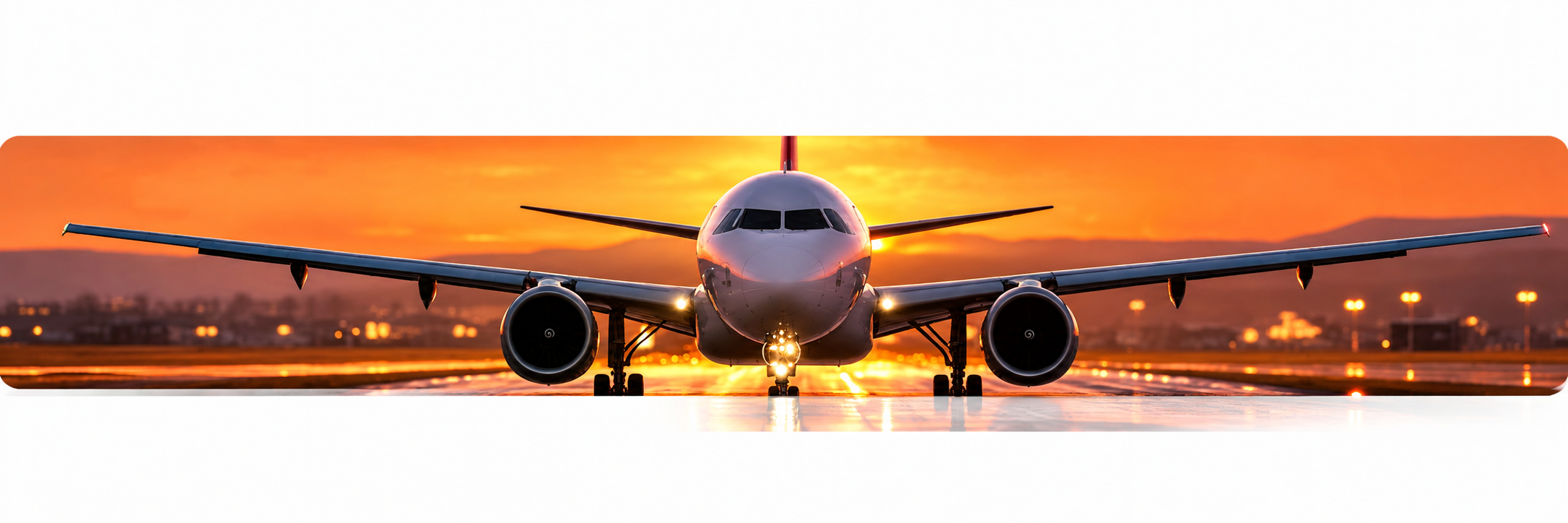
Quick answer: Airplanes stay in the air by generating an aerodynamic force called lift that directly opposes their weight. As an aircraft moves forward through the air, engines generate thrust to overcome aerodynamic drag, and the wings deflect air downward. According to Newton’s third law of motion, this downward turning of the airflow creates an equal and opposite upward reaction force. Simultaneously, air moving over and under the wings creates a pressure differential. This pressure distribution produces lift acting through the center of pressure, keeping the airplane safely airborne.
The Four Fundamental Forces of Flight
In powered flight, an aircraft operates under the continuous interaction of four physical forces: lift, weight, thrust, and drag.
- **Lift:** The upward aerodynamic force generated by the aircraft's motion through the air fluid, directly opposing the weight of the aircraft. - **Weight:** The downward gravitational force acting on the mass of the airplane, its fuel, passengers, and cargo. - **Thrust:** The forward mechanical force produced by propulsion systems—such as jet turbine engines or propellers—to push the plane through the air. - **Drag:** The backward aerodynamic resistance exerted by the air against the forward motion of the airplane structure.
When an airplane flies straight and level at a steady speed, these four forces remain in equilibrium. If thrust exceeds drag, the aircraft accelerates; if lift exceeds weight, the aircraft ascends.
Flow Turning and Pressure Distribution
To understand how wings create lift, Earth's atmosphere must be understood as a fluid gas composed of free-moving molecules. Because lift is a mechanical force produced by the physical contact between a solid body and a fluid, lift cannot be generated in a vacuum.
When a wing travels through the atmosphere, both its upper and lower surfaces deflect oncoming air downward. Applying Newton's third law of motion—action and reaction—turning the fluid airflow downward produces an equal and opposite upward reaction force on the wing. Simultaneously, the contour of the wing (its airfoil shape) and its angle relative to oncoming air (angle of attack) force air to travel differently across its upper and lower surfaces. This difference creates a lower pressure region above the wing compared to higher pressure underneath. This net pressure differential generates upward lift acting through a focal location on the aircraft known as the center of pressure.
Engine Thrust and Wing Efficiency
While the wings generate most of the lift on standard airliners, they require continuous forward velocity to maintain airflow across their surfaces. Jet engines or propellers supply the thrust necessary to push the aircraft forward and overcome aerodynamic drag.
To optimize fuel efficiency and aerodynamic performance, modern aircraft integrate specialized components. For example, winglets placed on wingtips reduce induced drag by mitigating wingtip vortices where high-pressure air below the wing attempts to roll into the low-pressure region above. During takeoff and landing, pilots deploy trailing-edge flaps and leading-edge slats to temporarily expand wing area and camber, increasing lift at lower airspeeds.
Operational Exceptions Across Aircraft Types
The conventional fixed-wing model explains commercial airliner flight, but operational mechanisms vary across aircraft types and environments:
- **Rotary-Wing Aircraft:** Helicopters generate lift using spinning rotor blades that act as rotating airfoils, allowing airborne operations and hovering without forward airplane movement. - **Vertical Takeoff and Landing (VTOL) Aircraft:** Aircraft like the AV-8B Harrier or F-35B Lightning II rely on vectored thrust—directing jet exhaust downward—to hover without relying on wing lift. - **Aerobatic Aircraft:** Planes designed with symmetrical airfoils (identical upper and lower curvature) generate lift entirely through angle of attack, enabling sustained inverted (upside-down) flight. - **Spacecraft:** Vehicles orbiting outside Earth's atmosphere, such as the Space Shuttle in space, remain aloft through orbital mechanics and gravitational velocity rather than aerodynamic wing lift, because the vacuum of space lacks atmospheric fluid.


